About the book
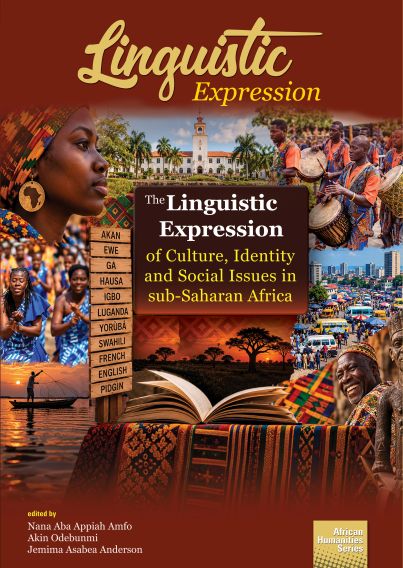
Linguistic expression of culture, identity, and social issues in sub-Saharan Africa is an edited collection of linguistic explorations that demonstrate how language can be used as an instrument for understanding a variety of societal issues in contemporary Africa.
Chapters are grouped into three sections:
- “Language, discourse and society” examines discourse as it interfaces with diplomatic relations, antisocial actions, and (self-)help in political, social, and medical contexts.
- "Language, culture and identity” describes the lexical, phonological, discoursal and pragmatic choices that language users make to meet different communicative needs shaped by sociocultural norms, societal dynamics and institutional character, using medical and everyday musical themes.
- “Language, flora and fauna” focuses on the interface among language, flora, and fauna, and how they manifest in sociocultural expression and communication.
Linguistic expression of culture, identity, and social issues provides intellectual material on politics, social life, culture, music, health and ecology, expressed through linguistic resources in languages of sub-Saharan Africa and is a useful resource for scholars in core and applied linguistics, as well as allied disciplines such as sociology, anthropology, political science, and musicology.
Reviewer’s Comments
... the chapters represent the state of the art in discourse analysis and allied sub-disciplines of linguistics.
Professor Kulikoyela Kahigi, University of Dar es Salaam, Tanzania
the contributions demonstrate rigorous research that is firmly grounded in current theories of linguistics and clear exposition that [...] makes the text accessible to linguists and non-linguists alike.
Professor Ron Simango, Rhodes University, South Africa
Part of the African Humanities Series
About the Authors
Nana Aba Appiah Amfo is Professor of Linguistics and Vice-Chancellor of the University of Ghana, Legon. A leading scholar in pragmatics, discourse analysis, and sociolinguistics, her research explores how language functions in social domains such as health, religion, gender, and politics. She has published widely in international journals contributing to the understanding of African multilingualism and pragmatics.
Akin Odebunmi teaches in the Department of English, University of Ibadan, Nigeria and is a past visiting professor in the Department of Linguistics, University of Ghana. His research interest lies in pragmatics and discourse analysis. He is a deputy editor of Bibliography of Pragmatics, Mentor on the International Pragmatics Association Mentoring Programme and recipient of the Alexander von Humboldt Fellowship Award for Experienced Researchers. He is widely published in international academic publications, particularly in pragmatics.
Jemima Asabea Anderson is an Associate Professor of Sociolinguistics and Pragmatics in the Department of English, the University of Ghana, Legon. She holds degrees from the University of Ghana and Indiana University, USA. She is interested in issues of (im)politeness in Ghanaian English, codification of Ghanaian English, language choice and language use in the media in Ghana, and linguistic landscapes, with several research articles published in pragmatics journals.
Contents
Notes on editors and authors
Introduction
SECTION 1 Language, Discourse and Society
Chapter 1: Unsettling the centre: Counter-securitisation of Ghana-US relations in media discourses on security cooperations
Chapter 2: “They are infidels and our enemies”: A discourse study of person deixis in the representation of the ‘Other’ in Boko Haram rhetoric
Chapter 3: “Check your BP today!”: Content structure and narrative types in health advice stories on Twitter Naija
Chapter 4: A critical discourse analysis of social media representations of “Japa” migration among Nigerians
Chapter 5: Language, identity and artiste rivalry in Nigerian female popular music lyrics
SECTION 2 Language, Culture and Identity
Chapter 6: Language choice and use in a rural Ruruuli-Lunyala speaking community
Chapter 7: Contextual modulations of bú ‘to break’ in Asante Twi
Chapter 8: They use millet to call a fowl – Rhetorical cues for bribery and corruption in Kusaal
Chapter 9: The socio-pragmatics of impoliteness in contemporary Igbo highlife songs
Chapter 10: Role identity construction in Nigerian and Ghanaian hospital encounters
SECTION 3 Language, Flora and Fauna in sub-Saharan Africa
Chapter 11: Morphosemantic Analysis of Chiyao plant names
Chapter 12: Agricultural activity verbs of planting in Tafi (tcd)
Chapter 13: Ecological signification through animal calls and sightings among the Iraqw of Tanzania